How Often Should EV Owners Check Tire Pressure and Alignment? It is a simple question, but it matters more for EV ownership than many drivers realize. Tire pressure and wheel alignment affect range, handling, ride comfort, tire wear, and even how predictable an EV feels during everyday driving.
Electric vehicles deliver instant torque, carry a substantial battery pack, and often use low-rolling-resistance tires designed to balance efficiency with grip. That combination makes tire condition particularly important.
A few PSI of pressure loss may not seem serious when you are heading to work, but over weeks and months, incorrect pressure can contribute to uneven wear, reduced efficiency, and a less comfortable drive.
Alignment deserves the same attention. You do not necessarily need an alignment every few months just because you own an EV. Instead, it should be checked when there are signs of a problem, after significant impacts, or according to the vehicle manufacturer’s maintenance guidance.
After years of practical EV and road experience, our approach is straightforward: check tire pressure frequently, monitor alignment through symptoms and inspections, and never wait for obvious tire damage before paying attention.
Why Tire Pressure Matters More in an EV
Every vehicle needs correctly inflated tires, but EV drivers have another reason to take pressure seriously: efficiency.
An EV converts stored electrical energy into movement. Any additional rolling resistance requires more energy to keep the vehicle moving. Underinflated tires can increase rolling resistance, meaning the motor has to work harder to maintain speed.
That can affect:
- Real-world driving range
- Energy consumption
- Tire temperature
- Tire wear
- Steering response
- Ride quality
- Braking behavior
The effect varies by vehicle, tire, road surface, temperature, and driving style, so it is not useful to promise a specific range loss from a particular pressure difference.
What is consistent is the principle: correct tire pressure helps the vehicle operate as designed.
How Often Should EV Owners Check Tire Pressure and Alignment to Prevent Tire Wear?
For most EV owners, checking tire pressure at least once a month is a sensible routine. It is also worth checking before a long road trip, after significant temperature changes, and whenever the vehicle’s tire-pressure monitoring system shows a warning.
Some drivers should check more frequently.
Consider checking every one to two weeks if you:
- Drive long distances regularly
- Carry heavy loads
- Frequently use rough roads
- Have experienced a slow puncture
- Notice pressure dropping between checks
- Drive through large temperature changes
- Have recently installed or repaired a tire
You should always use the manufacturer’s recommended cold-tire pressure rather than choosing a number based on what looks or feels right.
Check Tires When They Are Cold
This is one of the easiest details to overlook.
Tire pressure changes as the air inside the tire warms. After driving, the reading can be higher than it would be when the tires are cold.
For consistency, check pressure when the vehicle has been parked for several hours or follow the measurement conditions specified by the vehicle manufacturer.
The pressure listed on the vehicle’s door-jamb label or official documentation is generally more useful than the maximum pressure printed on the tire sidewall.
The two numbers serve different purposes.
The vehicle’s recommended pressure is the pressure intended for the vehicle’s normal operating requirements. The tire sidewall marking generally indicates a maximum pressure associated with the tire itself.
Temperature Can Change Your Tire Pressure
Seasonal temperature changes can catch drivers by surprise.
As ambient temperature drops, tire pressure generally falls. When temperatures rise, pressure generally increases.
This does not mean you should constantly adjust your tires every time the weather changes by a few degrees. Instead, major seasonal transitions are a good reminder to check all four tires.
For drivers dealing with cold winters, checking pressure when temperatures first drop can prevent weeks of driving with underinflated tires.
Hot-weather drivers should also avoid letting air out simply because a tire shows a higher pressure after a long drive. Check it again when cold and compare it with the manufacturer’s recommended value.
Don’t Forget the Spare or Repair Equipment
Some EVs do not have traditional spare tires. Depending on the vehicle, you may have an inflator, sealant kit, tire repair system, or another emergency solution.
If your EV uses a spare tire, include it in your inspection routine.
If it uses a repair kit, check the condition and expiration information of the sealant where applicable.
A perfectly maintained set of road tires does not help much if you discover during an emergency that your repair equipment is unusable.
What Does Proper Tire Pressure Feel Like?
Drivers sometimes try to diagnose pressure by the way an EV feels.
A tire that is noticeably underinflated may contribute to:
- Heavier steering
- Softer or less precise handling
- Increased rolling resistance
- Uneven shoulder wear
- Reduced efficiency
Overinflation can make the vehicle feel harsher over bumps and may reduce the tire’s intended contact behavior.
However, your hands and eyes should not replace a pressure gauge.
A reliable digital tire-pressure gauge is inexpensive and gives you an objective measurement.
How Often Should EV Alignment Be Checked?
Alignment does not necessarily follow the same monthly schedule as tire pressure.
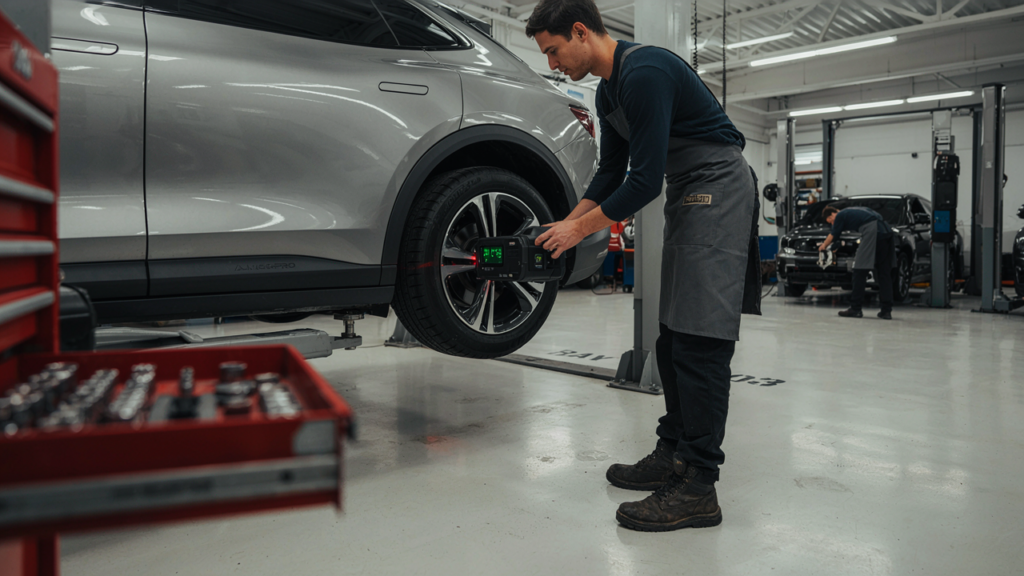
For many EV owners, alignment should be checked when there are symptoms, after a significant pothole or curb impact, after suspension work, when installing certain new tires, or according to the manufacturer’s maintenance recommendations.
Some vehicles may have specific inspection intervals, while others do not require routine alignment unless a problem develops.
This is why a blanket rule such as “get an alignment every six months” is not appropriate for every EV.
Instead, think of alignment as a condition-based maintenance item.
Signs Your EV May Need an Alignment Check
Pay attention to changes in how the vehicle drives.
Potential warning signs include:
The Vehicle Pulls to One Side
If the EV consistently moves toward the left or right on a reasonably level road when you are not steering, alignment may be worth checking.
Roads are not perfectly flat, however, and road crown can create some steering pull. A single observation is not enough to diagnose an alignment issue.
The Steering Wheel Is Off-Center
If the vehicle travels straight but the steering wheel sits noticeably crooked, the alignment or steering system may need inspection.
This is particularly worth checking after hitting a major pothole or curb.
Uneven Tire Wear
Look at the tread rather than simply checking whether the tire still has plenty of depth.
Uneven wear across the inner or outer edge can be a warning sign of alignment, suspension, pressure, or other mechanical issues.
The Vehicle Feels Unstable
Changes in steering response, wandering, or unusual behavior during normal driving deserve attention.
Do not automatically assume alignment is the cause. Tire pressure, tire condition, suspension components, road conditions, and other factors can produce similar symptoms.
Why EV Weight Makes Tire Condition Important
EV battery packs can add substantial mass compared with some similarly sized conventional vehicles.
That does not mean an EV automatically destroys tires. Tire life depends on many factors, including vehicle weight, tire compound, torque delivery, alignment, pressure, road conditions, driving style, and maintenance.
But the combination of vehicle weight and instant electric torque makes proper tire care particularly valuable.
Smooth acceleration helps.
Correct pressure helps.
Proper alignment helps.
Regular rotation, when recommended for the vehicle and tire setup, can also help promote more even wear.
Instant Torque Can Influence Tire Wear
Electric motors can deliver strong torque immediately.
That makes EVs responsive and enjoyable, but repeated hard launches can place additional stress on the driven tires.
You do not have to drive slowly to preserve your tires.
Instead, avoid making aggressive acceleration a constant part of your commute.
Progressive acceleration is usually easier on tires, passengers, and energy consumption.
It can also make the driving experience feel smoother.
Tire Pressure and Range: The Connection
Range discussions often focus on battery capacity, weather, speed, and heating or cooling.
Tires deserve a place in that conversation.
Rolling resistance is one of the forces an EV has to overcome while moving. Tire pressure influences how the tire deforms against the road, which can influence rolling resistance.
That means maintaining the recommended pressure is one of the simplest maintenance habits available to an EV owner.
It does not require an app, software update, expensive service appointment, or aftermarket modification.
A few minutes with a pressure gauge can help keep your vehicle closer to its intended operating condition.
Alignment Can Affect Your EV’s Efficiency Too
Alignment problems can also influence efficiency because a vehicle that is not rolling correctly may experience additional resistance.
The effect is not necessarily dramatic, and it should not be used to explain every small range difference.
Still, if an EV has developed severe alignment problems or abnormal tire wear, correcting the underlying issue can benefit both tire longevity and driving behavior.
The biggest reason to correct alignment is not simply to chase a tiny range improvement.
It is to keep the vehicle predictable and prevent unnecessary tire wear.
What About Tire Rotation?
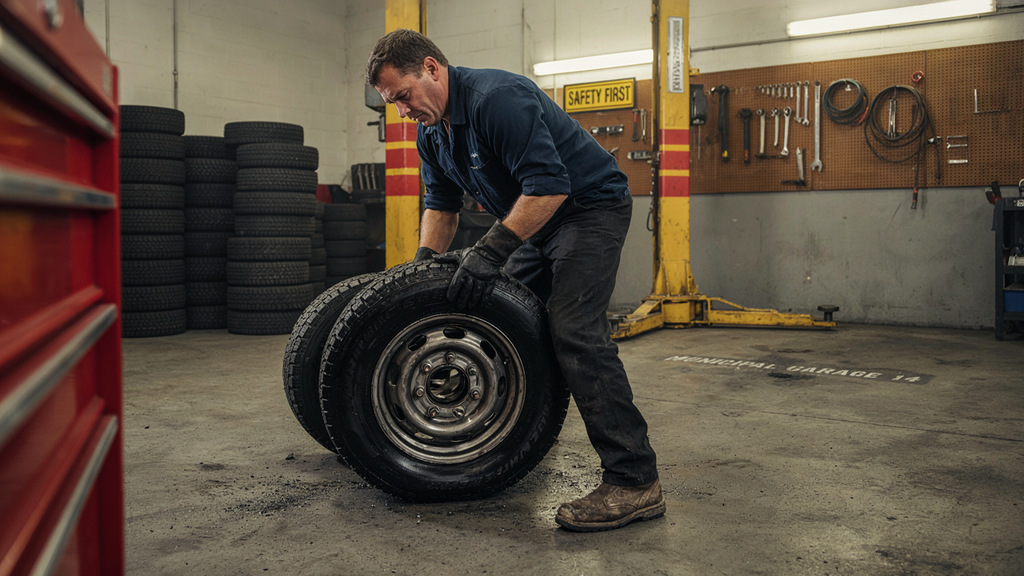
Tire rotation depends on the vehicle’s drivetrain, tire design, tire size, and manufacturer’s recommendations.
Some EVs use identical tires at all four corners, while others have different front and rear specifications. Directional or asymmetric tires can also have specific rotation requirements.
Do not assume every EV should use the same rotation pattern.
Check the owner’s manual or tire manufacturer’s guidance before rotating.
If rotation is recommended, keeping up with it can help distribute wear more evenly.
A Simple Monthly EV Tire Check
You can perform a basic tire inspection without special mechanical knowledge.
Start by checking the pressure of all tires when cold.
Then inspect the tread and sidewalls.
Look for:
- Nails or screws
- Cuts
- Bulges
- Cracks
- Uneven tread wear
- Objects stuck in grooves
- Abnormal wear on one edge
Next, look at the valve area for obvious damage or leakage.
Finally, make sure the tire-pressure monitoring system is functioning correctly.
This takes only a few minutes but can reveal problems before they become expensive.
When You Should Get an Alignment Checked Immediately

Some situations justify a quicker inspection.
Consider getting the vehicle checked after:
- A major pothole impact
- Hitting a curb
- A collision
- Suspension repairs
- Steering-component replacement
- Sudden uneven tire wear
- Persistent steering pull
- A steering wheel that becomes noticeably off-center
A strong impact does not guarantee that alignment has changed, but it is a reasonable reason to inspect the vehicle.
Don’t Confuse Alignment With Balancing
These services are different.
Wheel alignment concerns the angles and positioning of the wheels relative to the vehicle and road.
Wheel balancing addresses uneven weight distribution around a wheel and tire assembly.
A vibration at certain speeds may point toward a balancing issue rather than alignment.
Likewise, a vehicle pulling to one side may have an alignment-related issue, but other causes are possible.
Correct diagnosis matters because replacing or adjusting the wrong component wastes money.
A Practical Maintenance Schedule
Here is a simple starting framework:
| Check | Suggested Timing | Why It Matters |
| Tire pressure | Monthly | Supports efficiency, handling, and tire life |
| Tire pressure before long trip | Before departure | Confirms correct cold pressure |
| Tread inspection | Monthly | Finds wear and damage early |
| Sidewall inspection | Monthly | Detects cuts, cracks, and bulges |
| Tire rotation | Manufacturer schedule | Helps manage uneven wear |
| Alignment inspection | Symptoms/impact/service interval | Prevents abnormal wear |
| Wheel balance | When vibration occurs or service requires | Supports smooth operation |
| TPMS check | When warning appears | Identifies pressure problems |
This is a practical baseline, not a replacement for the maintenance schedule specific to your EV.
What EV Owners Often Get Wrong
One common mistake is assuming that the tire-pressure monitoring system eliminates the need for manual checks.
TPMS is useful, but it should not become an excuse to ignore your tires.
Another mistake is checking only the visibly damaged tire.
Pressure should be measured across all tires because gradual pressure loss can happen independently.
We also see drivers focus heavily on battery health while overlooking tires.
A healthy battery cannot compensate for a damaged, badly worn, incorrectly inflated, or poorly aligned tire.
How to Make Tire Checks Part of Your Routine
The easiest maintenance habit is the one you connect to something you already do.
For example, choose the first weekend of every month.
Check the tire pressure.
Walk around the vehicle.
Look at tread condition.
Check for visible damage.
It becomes a five-minute routine rather than another task you continually postpone.
Before road trips, perform another check.
After a serious pothole, do not wait for your normal monthly inspection if the vehicle suddenly feels different.
Final Thoughts
Knowing how often EV owners should check tire pressure and alignment does not require an unnecessarily complicated maintenance routine.
Check tire pressure regularly, ideally about once a month and before longer journeys, while following your manufacturer’s specified pressure. Inspect tires visually at the same time.
Alignment is different. It generally does not require a universal monthly or six-month appointment.
Instead, monitor how the vehicle drives, watch for uneven tire wear, and have the alignment checked after significant impacts, relevant repairs, noticeable symptoms, or at the interval specified by your vehicle manufacturer.
For EV owners, these simple habits protect more than tires. They can support predictable handling, efficient driving, better ride quality, and lower chances of premature tire replacement.
The battery may be the most talked-about component in an EV, but the tires are still where your vehicle meets the road. Taking care of that connection is one of the simplest ways to make everyday electric driving more reliable.
Frequently Asked Questions(FAQs)
1. How often should I check tire pressure on an EV?
Most EV owners should check tire pressure at least once a month and before long trips. Drivers who frequently carry heavy loads, use rough roads, or experience pressure loss may benefit from checking more frequently.
2. Do EVs need wheel alignment more often than gas cars?
EVs do not automatically require more frequent wheel alignments simply because they are electric. Alignment needs depend on the vehicle, roads, suspension, tire wear, and impacts. Manufacturer recommendations and driving symptoms are better guides than a fixed universal interval.
3. Does low tire pressure reduce EV range?
Low tire pressure can increase rolling resistance, which may require additional energy to move the vehicle. The actual range effect varies with pressure, tires, temperature, speed, road conditions, and vehicle design, so there is no single percentage that applies to every EV.
4. What are the signs that an EV needs a wheel alignment?
Common signs can include persistent pulling to one side, an off-center steering wheel, uneven tire wear, or changes in steering behavior. However, these symptoms can have multiple causes, so proper inspection is necessary before assuming alignment is responsible.
5. Should EV tire pressure be checked when the tires are hot or cold?
For the most consistent measurement, tire pressure should normally be checked when the tires are cold, following the vehicle manufacturer’s instructions. Driving heats the tires and can temporarily increase the pressure reading.
You might also like the following…
- 5 Proven Benefits of Electric Car Brake Service
 Electric car brake service is an important part of maintaining an electric vehicle, even though EVs often need brake pad replacements less frequently than gasoline-powered cars. Thanks to regenerative braking, electric cars can reduce friction-brake… Read more: 5 Proven Benefits of Electric Car Brake Service
 - 10 Essential Tips to Inspect Before a Long EV Road Trip Safely
 Planning a long electric vehicle road trip involves more than charging the battery to 100% and entering a destination into your navigation system. Before leaving home, it is worth checking your tires, brakes, charging equipment,… Read more: 10 Essential Tips to Inspect Before a Long EV Road Trip Safely
 - How to Avoid Wasting Money on Trendy EV Add-Ons
 How to Avoid Wasting Money on Trendy EV Add-Ons is becoming an important question for EV owners. Once you buy an electric vehicle, it is surprisingly easy to keep spending money on products that promise… Read more: How to Avoid Wasting Money on Trendy EV Add-Ons