

How to Calculate Cost per Mile for an Electric Vehicle is one of the simplest ways to understand what you are really spending every time you drive. An EV does not use gasoline, so instead of looking at dollars per gallon and miles per gallon, you need to look at electricity price and energy consumption.
The good news is that the calculation is straightforward. Once you know your EV’s electricity consumption and the price you pay per kilowatt-hour (kWh), you can work out your approximate charging cost per mile, monthly driving cost, and even yearly energy expense.
At Engine Saga, we prefer looking beyond the number shown on a vehicle’s window sticker.
Real-world driving, weather, traffic, charging losses, driving style, and electricity rates can all change what you actually spend. So, let’s break down the calculation in a way that makes sense for everyday EV ownership.
How Do You Calculate EV Cost Per Mile?
The basic formula is:
EV cost per mile = Electricity consumption per mile × Electricity price per kWh
If your vehicle uses 0.30 kWh per mile and your electricity costs $0.15 per kWh:
0.30 × $0.15 = $0.045 per mile
That means you are spending approximately 4.5 cents per mile on electricity.
You can also calculate it from a vehicle’s kWh-per-100-miles figure:
Cost per mile = (kWh per 100 miles × electricity price) ÷ 100
For example, an EV consuming 30 kWh per 100 miles at $0.15/kWh would cost:
(30 × $0.15) ÷ 100 = $0.045 per mile
The U.S. Department of Energy uses the same basic relationship between electricity price, EV efficiency, and charging cost.
Step 1: Find Your EV’s Energy Consumption
Before calculating cost, you need to know how much electricity your vehicle uses.
EV efficiency is commonly shown in one of two ways:
- Miles per kWh (mi/kWh)
- kWh per 100 miles
Both describe the same basic thing from different directions.
For example, suppose your EV averages 3.5 miles per kWh.
To find its energy consumption per mile:
1 ÷ 3.5 = 0.286 kWh per mile
For 100 miles:
0.286 × 100 = 28.6 kWh per 100 miles
A vehicle’s official efficiency figure is useful for comparison, but real-world efficiency can be different. Speed, temperature, tire pressure, hills, traffic, climate control, cargo, and driving habits all influence consumption.
That is why we recommend using your own vehicle’s long-term average when possible.
Step 2: Check Your Electricity Rate
Next, find your electricity price.
Look at your utility bill and find the amount charged per kWh. Your actual rate may include more than the basic energy charge, depending on your utility and billing structure.
For example, if your effective electricity cost is:
$0.18 per kWh
and your EV consumes:
0.30 kWh per mile
your charging cost becomes:
0.30 × $0.18 = $0.054 per mile
So your EV costs about 5.4 cents per mile for electricity.
This is where EV ownership can become very interesting. Two people driving identical vehicles can have noticeably different charging costs simply because they pay different electricity rates.
Some utilities also use time-of-use pricing, meaning electricity can cost different amounts at different times of day.
Step 3: Calculate the Cost of a Full Charge
The battery’s capacity gives you another useful calculation.
Imagine an EV has a 60-kWh battery and electricity costs $0.18/kWh.
A simple full-charge calculation is:
60 × $0.18 = $10.80
So, theoretically, 60 kWh of electricity would cost $10.80.
However, this does not always mean your actual wall-to-battery charging cost will be exactly $10.80. Charging involves energy losses, and the amount of electricity drawn from the wall can be higher than the energy ultimately stored in the battery.
For everyday budgeting, it is better to use your actual charging-session energy consumption whenever that information is available.
Step 4: Include Charging Losses
This is one of the details that can make an EV cost-per-mile calculation more realistic.
The electricity that reaches the battery is not necessarily equal to the electricity drawn from the grid. Charging equipment and the vehicle’s charging system consume some energy during the process.
For example, imagine your vehicle adds 30 kWh to the battery, but the charger draws slightly more from the electrical supply.
If you calculate your cost using only the energy added to the battery, you may slightly underestimate your real electricity expense.
For accurate household budgeting, the best approach is to use the energy recorded by your charging equipment, utility monitoring system, or other reliable charging data when available.
Charging equipment efficiency can affect the amount of energy wasted during charging, which is another reason real-world electricity consumption can differ from simple battery-capacity calculations.
A Simple EV Cost-Per-Mile Example
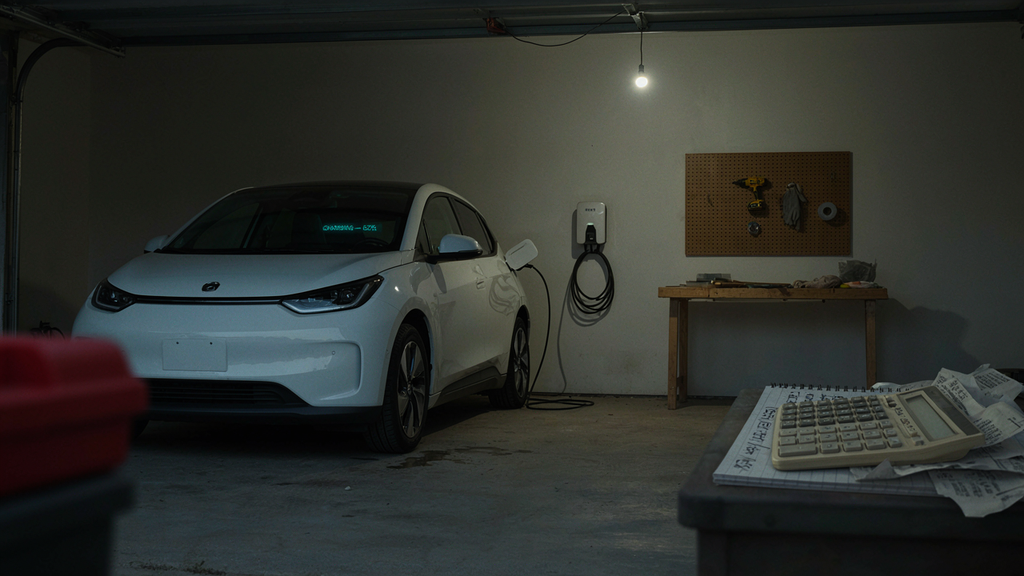
Let’s put everything together.
Imagine you drive an EV that averages:
- 3.2 miles/kWh
- Electricity price: $0.16/kWh
- Annual driving: 12,000 miles
First, calculate energy consumption per mile:
1 ÷ 3.2 = 0.3125 kWh per mile
Now multiply by electricity cost:
0.3125 × $0.16 = $0.05 per mile
Your approximate electricity cost is therefore:
5 cents per mile
For 12,000 miles:
12,000 × $0.05 = $600 per year
That gives you a simple estimate of annual charging energy.
Keep in mind that actual results can be higher or lower depending on charging losses, temperature, driving conditions, and where you charge.
Why Your Real EV Cost Per Mile Can Change
The number on paper is useful, but experienced EV owners know that efficiency moves around.
Driving Speed
High-speed driving can increase energy consumption because aerodynamic resistance becomes more significant as speed rises.
A vehicle that performs impressively around town may use considerably more electricity during sustained highway driving.
Weather
Cold weather can reduce efficiency because the battery operates under different thermal conditions and cabin heating requires energy.
Hot weather can also increase energy use when air conditioning runs heavily.
Tire Pressure
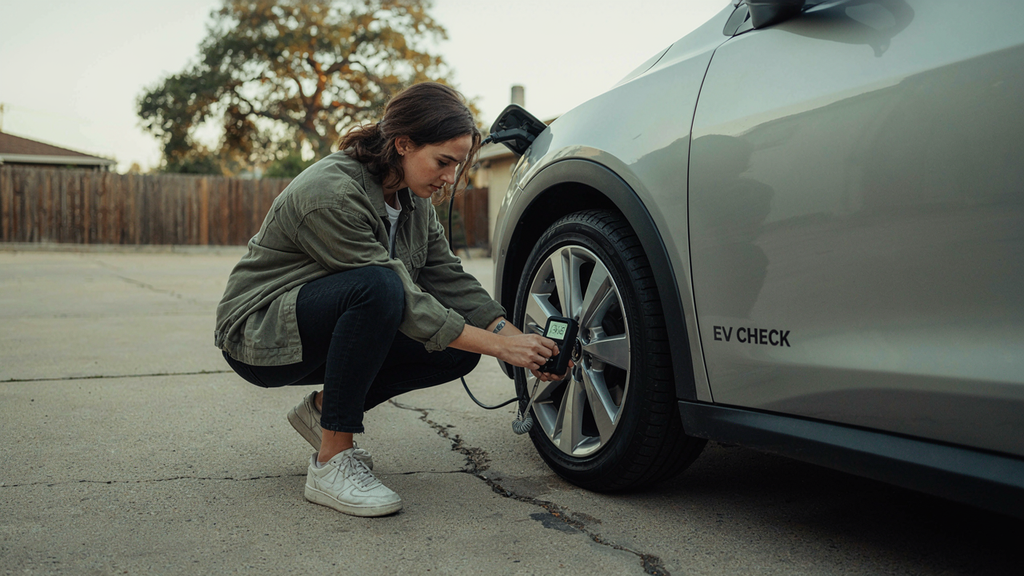
Underinflated tires create additional rolling resistance. Keeping tires at the manufacturer’s recommended pressure can help maintain predictable efficiency and tire wear.
Traffic
Stop-and-go traffic can produce mixed results. Regenerative braking can recover some energy during deceleration, but repeated acceleration still requires energy.
Climate Control
Heating and air conditioning consume electricity. On short trips, their effect can be particularly noticeable because climate-control energy represents a larger share of total trip consumption.
Cargo and Passengers
Additional weight requires more energy, particularly during repeated acceleration and uphill driving.
This is why we recommend tracking your own EV rather than assuming the advertised efficiency number will always match your daily driving.
Home Charging vs Public Charging Cost
Where you charge can have a major effect on your cost per mile.
Home charging is often easier to budget because your electricity rate is usually tied to your utility bill. Public charging can have different pricing structures, including per-kWh charges, session fees, membership pricing, or other fee arrangements.
That means the same EV can have one cost per mile at home and another at a public charging station.
For example:
| Charging Method | Effective Energy Cost | EV Efficiency | Approx. Cost/Mile |
| Home | $0.15/kWh | 3.5 mi/kWh | 4.3¢ |
| Home | $0.20/kWh | 3.5 mi/kWh | 5.7¢ |
| Public | $0.35/kWh | 3.5 mi/kWh | 10.0¢ |
| Public | $0.45/kWh | 3.5 mi/kWh | 12.9¢ |
These are examples rather than universal charging prices. The important lesson is that electricity price matters just as much as vehicle efficiency when calculating cost per mile.
How to Calculate Your Monthly EV Driving Cost
Once you know your cost per mile, estimating your monthly electricity expense becomes easy.
Use:
Monthly EV charging cost = Monthly miles × EV cost per mile
Suppose you drive:
1,000 miles per month
and your EV costs:
$0.05 per mile
Then:
1,000 × $0.05 = $50
Your estimated monthly electricity cost would be around $50.
This simple calculation is particularly useful when creating an EV ownership budget.
EV Cost Per Mile vs Gasoline Cost Per Mile
The same approach can be used for a gasoline vehicle.
For a gasoline vehicle:
Gas cost per mile = Price per gallon ÷ Miles per gallon
Suppose gasoline costs $3.50 per gallon and a vehicle averages 30 mpg:
$3.50 ÷ 30 = $0.117 per mile
That is about 11.7 cents per mile for fuel.
For an EV, you use electricity consumption instead.
This comparison can help show why an EV’s energy cost can be attractive, although the complete ownership calculation should also include insurance, maintenance, tires, financing, depreciation, registration, and other expenses.
Does Cost Per Mile Include EV Maintenance?
Not automatically.
When we calculate electricity cost per mile, we are measuring the cost of energy used for driving. It does not automatically include maintenance or ownership expenses.
A broader ownership calculation could include:
- Electricity
- Tires
- Routine maintenance
- Repairs
- Insurance
- Registration
- Depreciation
- Financing costs
- Charging equipment
- Home charger installation
This distinction matters.
An EV can have a low electricity cost per mile without necessarily being the cheapest vehicle to own overall. Total cost of ownership tells a much bigger story.
The U.S. Department of Energy has also highlighted that EV operating and maintenance economics should be considered together when evaluating ownership costs.
The Best Way to Track Your Real EV Cost Per Mile
If you want an accurate number rather than an estimate, track your EV for several months.
Record:
- Miles driven.
- Electricity used.
- Home charging cost.
- Public charging cost.
- Average efficiency.
- Weather conditions when useful.
- Major highway versus city driving.
At the end of the month, divide your total charging expense by your total miles.
For example:
$62 charging expense ÷ 1,200 miles = $0.0517 per mile
Your real charging cost would be approximately 5.2 cents per mile.
After several months, you will have a much more useful number than a single trip or manufacturer estimate.
How to Reduce Your EV Cost Per Mile
You do not need to drive painfully slowly or avoid using climate control to reduce energy costs.
Instead, focus on simple habits:
- Keep tires properly inflated.
- Avoid unnecessary aggressive acceleration.
- Maintain a steady speed when traffic allows.
- Remove unnecessary cargo.
- Use regenerative braking effectively.
- Take advantage of lower-cost charging periods where available.
- Prefer efficient routes when practical.
- Monitor your vehicle’s long-term efficiency.
- Use home charging when it makes financial sense.
- Keep the vehicle maintained according to manufacturer recommendations.
The goal is not to obsess over every watt-hour. It is to build habits that naturally keep energy consumption under control.
Final Thoughts
Learning How to Calculate Cost per Mile for an Electric Vehicle gives you a much clearer picture of everyday EV ownership. The basic calculation is simple, but the most useful number comes from real driving data rather than relying entirely on a laboratory efficiency rating.
Start with your EV’s kWh consumption, check your electricity rate, and multiply the two. Then improve the estimate by considering charging losses, public charging prices, weather, driving conditions, and your actual monthly mileage.
At Engine Saga, we believe the best ownership decisions come from practical numbers. Once you know what each mile really costs, you can build a smarter charging routine, compare EVs more confidently, and understand whether your vehicle is delivering the running-cost savings you expected.
Frequently Asked Questions(FAQs)
1. What is a good cost per mile for an electric vehicle?
There is no single ideal number because electricity prices and EV efficiency vary considerably. A highly efficient EV charged at a low electricity rate can have a very low energy cost per mile, while an inefficient vehicle using expensive public charging can cost substantially more.
2. How do I calculate EV charging cost per mile at home?
Find your household electricity price per kWh and your EV’s electricity consumption. Multiply kWh used per mile by the electricity rate. For example, 0.30 kWh per mile at $0.18/kWh equals about 5.4 cents per mile.
3. Does EV cost per mile include charging losses?
A basic calculation may not include charging losses. For a more accurate real-world figure, measure the electricity drawn from the electrical supply rather than relying only on the energy stored in the battery. This gives you a better picture of actual charging expense.
4. Is an EV cheaper per mile than a gasoline car?
An EV can have a lower energy cost per mile than a comparable gasoline vehicle, but the result depends on electricity prices, gasoline prices, vehicle efficiency, and charging location. For a fair ownership comparison, maintenance, insurance, depreciation, and other expenses should also be considered.
5. How can I lower my electric vehicle cost per mile?
The easiest improvements usually come from maintaining correct tire pressure, avoiding unnecessary aggressive acceleration, limiting excess weight, using efficient driving habits, and charging when electricity rates are favorable. Tracking your actual consumption is the best starting point.
You might also like the following…
- 5 Proven Benefits of Electric Car Brake Service
 Electric car brake service is an important part of maintaining an electric vehicle, even though EVs often need brake pad replacements less frequently than gasoline-powered cars. Thanks to regenerative braking, electric cars can reduce friction-brake… Read more: 5 Proven Benefits of Electric Car Brake Service
 - 10 Essential Tips to Inspect Before a Long EV Road Trip Safely
 Planning a long electric vehicle road trip involves more than charging the battery to 100% and entering a destination into your navigation system. Before leaving home, it is worth checking your tires, brakes, charging equipment,… Read more: 10 Essential Tips to Inspect Before a Long EV Road Trip Safely
 - How to Avoid Wasting Money on Trendy EV Add-Ons
 How to Avoid Wasting Money on Trendy EV Add-Ons is becoming an important question for EV owners. Once you buy an electric vehicle, it is surprisingly easy to keep spending money on products that promise… Read more: How to Avoid Wasting Money on Trendy EV Add-Ons